


Chelsea Bieker, Madwoman (September 2024); reviewed 04/26/24
My thanks to NetGalley and little, Brown & Company for the ARC of Chelsea Bieker’s Mad Woman.
Content warning: intimate partner violence, murder, generational trauma
Two,things attracted me to the synopsis of this book: the premise of a woman changing her identity to escape her traumatic childhood and the setting in Portland, OR. Having grown up in Portland, I had more of a sense of connection to the area and the types of all natural, raw food, vegan, organic, prebiotic munching, health obsessives like the main character. She is like one of Gwenyth Paltrow’s GOOP devotees, intent on preserving her body in every way, except for this protagonist that drive is a manifestation of a need to control a life that felt out of control in childhood. So much about this book works beautifully… right up until the twist at the end and the resolution, which I found less satisfying.
The protagonist’s voice, though, her desire to be a perfect mother and wife (no such thing), to not repeat her mother’s life choices or allow the violence her father visited on them both, all felt quite real. So did her shopping addiction, her desire to connect with another woman seeking something different. All of it lays the groundwork for the conclusion. When she hears from her mother, imprisoned for her father’s murder, she fears her husband will learn who she really is and what her background was. She goes into a (very privileged) tail spin of exercise, health food stores, supplements, shopping, relying first on her mother in law and then on a total stranger to nanny her children. Admittedly I found it hard to empathize with a woman with so much privilege no matter her background. I raised three boys, two of whom were twins, and never had a nanny much less prebiotic fiber gummies and shopping sprees.
Yet, the book is still a page turner. I was leaning toward a five star rating until the twist and conclusion. I cannot pinpoint what sat wrong with me there, except to say that it seemed less plausible than all that had gone before. At any rate, the book is still compelling and the mystery surrounding so much of Clove’s life comes out much as traumatic memories do, incomplete, patchy, over time, and not always accurate.

Kaliane Bradley, The Ministry of Time (May 2024); reviewed 03/06/24
My thanks to NetGalley and Simon & Schuster for the ARC of The Ministry of Time by Kaliane Bradley.
**SPOILERS***
I loved this book so much! I hope it gets made into a movie. Consider its recipe: time travel, historical fiction, romance, spy thriller. YES, PLEASE. Turns out Capt. Graham Gore was a real person in the doomed Franklin expedition. Bradley imagines a scenario in which 19th-century Gore is plucked from his own timeline by a secret ministry in the UK, whose goal is partly to fix climate change before it occurs. He is not alone though, because the Ministry pulls several other characters from different centuries in too, all of who become a cohort of acclimation to the twenty-first century. To make that transition, each is assigned a “bridge,” an officer responsible for living with the “expat” (I.e., time traveler) and teaching them about modern life and the history they missed.
But it turns out that Gore is the stuff of a Bond film: ruggedly handsome (think Tom Hardy), charismatic, charming, likes to cook, learns to ride a motorcycle in leathers (please cast Tom Hardy in this film), can draw, plays the flute, and eventually, and unsurprisingly, becomes a hot, hot lover. For a time, the expats and bridges make friends, go clubbing, and have fun. That is until they realize they are being hunted by the future at the same time.
I hesitate to say more because I don’t wanna spoil so much that is wonderful about this book. Anyone who enjoys books liked Kindred (this imagines the time traveler moving forward in history but similarly having to grapple with historical problems and ethics), spy, novels (feels a bit Mr and Mrs Smith at moments, sexually tension, both highly trained agents, etc.),, or the recent Emily Wilde (similar romance) fairy books, will probably enjoy this book. Read it!
To those claiming this books is the same as the Spanish series of the same name, other than the title the two narratives are wholly different. I read the book and then watched the series.
Elliott Gish, Grey Dog (April 2024); reviewed 10/25/23
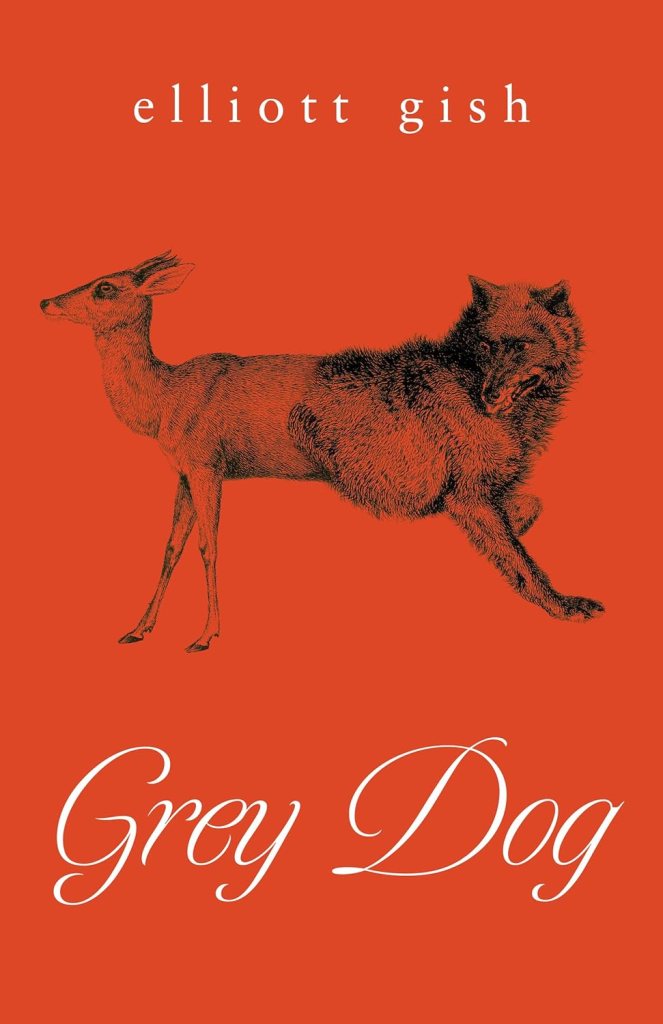
My thanks to NetGalley and ECW Publishing for this ARC of Elliott Gish’s Grey Dog, which I received in exchange for my free and unbiased review. If you love Jane Eyre, Villette, and films like The VVitch and Midsommer, if Sarah Waters novels are also your jam, you will love this book, which is like a glorious mash up of all of those. Quick synopsis: spinster teacher with a problematic past and queer desires moves to small community for her second chance as a teacher. I fear to say more beyond that because the plot is at once so simple and so atmospheric that I think I would absolutely spoil much that makes this novel work. It is a slow burn, and those usually lose me, but Gish’s writing is excellent and kept me pulled through from eerie moment to eerie moment as her protagonist unravels…. Or taps into her well-earned rage. I’m hoping for more from Gish, who impressed with this first novel.
Jen Silverman, There’s Going to Be Trouble (April 2024); reviewed 10/16/23
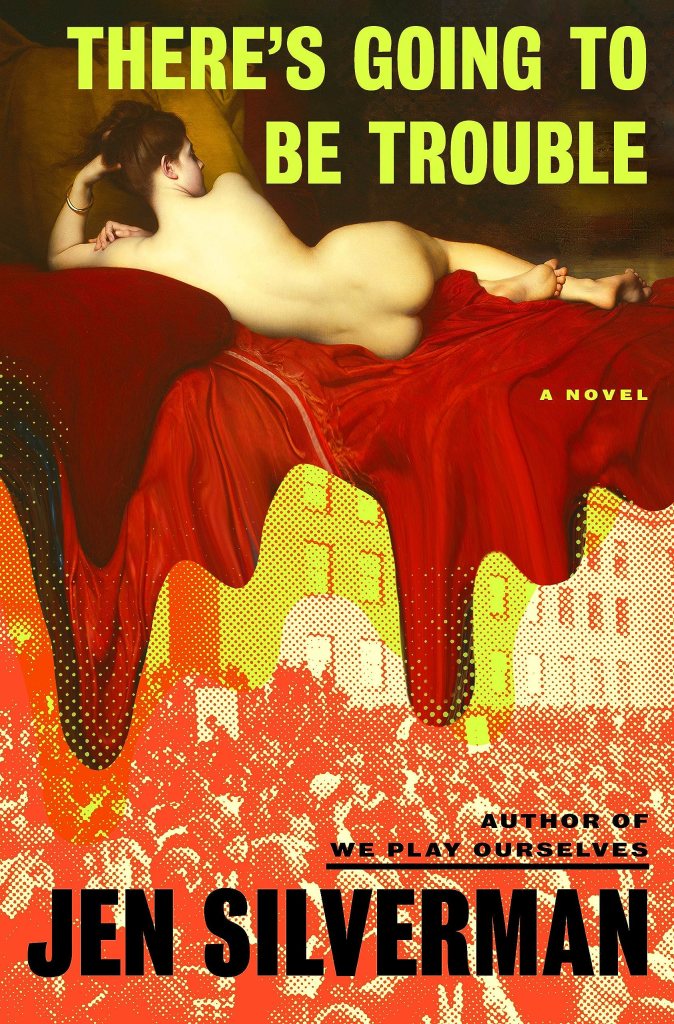
My thanks to NetGalley and Random House for the ARC read, which I received in exchange for my free and unbiased review of Jen Silverman’s There’s Going to be Trouble.
Wow. What a timely novel of political protest, abortion rights, late stage capitalism, family, and those who seek change in a broken world. Silverman has Crafted a tour de force, a novel, with nearly perfect pacing, one that had me turning pages as she sustains its narrative from the first page to the last. I had no signs of any lulls in this book. My sense is that that pacing for something to do with the structure of two protagonists: Minerva/Minnow/Minou, and her father Keene/Christopher Hunter. As the narrative oscillates between Christopher‘s relationship with Olya in 1968 and the political protest at Harvard with which they were involved, and forward to Minnow’s life in Paris, relationship with Charles, and political protests in that city, the pace is driven forward by their respective relationships, their mutual attempts to make enduring change world, and the political protest themselves.
As if that structural choice weren’t complex and clever enough, Silverman centers, Minnow’s reason for having to move to Paris in the first place in the middle of the novel. For the first half of the novel, there are only these hints at some thing having gone wrong in Minnow’s teaching job back in the United States, and her ultimately having to quit her job. But when we arrive at the middle of the novel, we learn that what caused her to have to quit her job was that she had agreed to drive a 16 year-old student to an abortion clinic across state lines. In that moment, as a reader, you.realize that Silverman has given us is a post -Roe world comparison of abortion, access, morality, and attitudes in the United States versus a country like France. When Minnow tells her boyfriend Charles in Paris, the reason that she had to leave the United States, his reaction is, “you can get in trouble for that?” It’s such a foreign concept to Charles and others that Minnow encounters in Paris that abortion rights are not assumed and automatic in the United States but also that somebody would be pilloried in the media and forced to quit their job over helping to take a woman to an abortion clinic. As it turns out, Minnow’s life is destroyed in the United States by protests nationally and in her very conservative former State, who publicly deride her, send her death threats, and even stalk her.
What Silverman really seems to be working through here is the cost-benefit of political protest, the individual and collective ability to create change through protest, or not, and the ethics of standing up for what you believe in. And, I find it so compelling that she doesn’t just give pat answers. Her characters really struggle with the rights and wrongs of these questions. Each of her characters is deeply conflicted and finding their way, just like actual humans do. And so for that, this book earns one of my rare five star ratings. I think it’s going to be a really prominent important and best-selling novel when it comes out. Applause to Silverman for crafting a narrative that has enduring value and is intensely readable. I could not put it down.
E. Lily Yu, Jewel Box: Stories (October 2023); reviewed 09/30/23

I received this book as an ARC from NetGalley and Erewhon publishing for my free and unbiased review. My thanks to them for the opportunity.
What a delightful, beautiful collection of short fiction! Yu’s writing evokes that of ancient fairy tales, each narrative drawing the reader in as though one is listening by the fireside. From a heartbreaking love story between a street lamp and a young man that takes a posthumanist twist, to a story about overlord hornets and revolutionary bees, Yu surprises, critiques, and satirizes at each turn. This collection is one of the best short story collections I have had the pleasure to read in recent years.
“The Doing and the Undoing of Jacob Mwangi” recalled Vonnegut’s “Harrison Bergeron,” while “Green Glass: A Love Story” wraps commentary on climate change and late stage capitalism in a cloak of white wealthy privilege at a wedding where ice cream is the goal. Following these, Yu imagines an alien encounter in which humans and their governments are no more welcoming and empathetic to visitors from another world than they currently are to refugees and immigrants. Really, from story to story, Yu’s work is a stunning, refreshing treat, Jewel Box, indeed.
Edan Lepucki, Time’s Mouth (July 2023); reviewed 06/28/23

I received an ARC from the publisher for my free, unbiased review of the book. This novel is available August 2023.
*****Keywords*****: time travel, parenthood, trauma, generational trauma, California
It’s rare that I give a novel an unfettered five-star review. To do so means (to me) that the book was truly exceptional, standing out among the thousands of books I’ve read in a half century of life. The book has to have lucid prose, realistic dialogue, an original driver, and thematic investments that the author has woven throughout, among other attributes. Moreover, the book has to make me finish with a “Wow,” some silence, and then I want to read it again or tell everyone about it. Better still: I will already be thinking about how I can teach the book.
Edan Lepucki’s Time’s Mouth deserves every one of its five stars. It accomplishes all of the qualifications for that rating and more. It’s fair to say that writing an original time travel novel is a hard ask. Lepucki knows this, if her cameo for Octavia Butler is any indication. While Butler’s Kindred thinks about historical trauma, generational trauma, and race, Lepucki leans into generational trauma in ways relevant to gender.
“Motherhood and loss, loss and motherhood—they went hand in hand. Your child isn’t who they were the day before, they are slipping through your fingers, they can walk, and now they can drive, and, if you’re lucky, they survive, they grow up and move on from you. Ursa realized with a sudden, seizing flash that by transporting she’d rejected the central sacrifice of parenthood. She never let him leave her.”
Man, this quote got me in the motherhood feels hard. I’ve often talked with friends about how motherhood involves a constant mourning of your child as they were, even as you (hopefully) celebrate who they become. I cannot recall a book that gets that truth the way Lepucki’s does. What’s more, she binds that loss up in a sticky web of generational trauma that swallows members of an entire family.
SPOILERS AHEAD — STOP READING IF YOU DON’T WANT TO KNOW TOO MUCH
I find myself hard-pressed to say who the protagonist of the novel is, and I suspect that’s by design. At the outset, we learn about Ursa (neé Sharon), who hints several times at sexual abuse from a monstrous father by the age of ten. Having left home, she finds her way to San Francisco, but not before she has her first experience of time travel, or what she calls “transporting.” She has an experience where she slips from her own moment into a past one: more than a memory, then-Sharon can feels, smell, taste, hear, see everything happening to her prior self in the moment, observing her prior self from a corner of a room like, we will later find, a poltergeist. When Sharon first transports, she is starting her period, and Lepucki makes of menstruation a kind of cosmic font through which Ursa (and later her granddaughter Opal) can focalize back in time.
When then-Sharon arrives in San Francisco and becomes Ursa, we find that rather than healing from her childhood trauma, she has learned to make use of others: sexually, emotionally, financially. She literally starts a cult of “Mamas” on a friend’s remote property outside of Santa Cruz, where women raise fatherless children (no judgment from me about the fatherless part, but definitely judgment about the children being locked up, neglected, and traumatized in other ways), farm the land (ultimately starting a lucrative marijuana operation), and essentially serve as acolytes to Ursa. On a monthly basis (of course at the full moon), they gather in a hexagonal geodesic dome with an oculus to feed off of the energy Ursa’s transportations generate. (Here a cameo nod to Margaret Atwood’s Handmaid’s Tale when the Mama’s invoke the phrase “May the moon open.”) Later, this secondary energy is called orgasmic and can still be rubbed off in its tertiary form as hugs. So the Mamas stay, abandoning themselves to Ursa’s service, and abandoning their children on site essentially. The children are literally locked in “the purple room” during Ursa’s transports in something that might evoke Flowers in the Attic for you other Gen X babies out there.
In the midst of this space, Ursa gives birth to her son Ray, who is raised around the other Mamas likewise catch-off children, one of whom is Cherry. Cherry was born to Ruth and Charlie. Charlie used to be one of Ursa’s lovers. Ursa is jealous when they show up. Then Charlie leaves, and we find out near the end of the book that Ursa talks Ruth into abandoning Cherry with her (sort of). Ursa essentially kidnaps Cherry, who she doesn’t even want. All of this happens by the first quarter of the book!
Ray and Cherry, now teenagers, begin a love affair and run off together when Cherry announces she’s pregnant. They move to LA where they hide from Ursa and the Mamas, trying to be “normal” and happy for a while. When Opal is born, they’re both in love with her, until the baby begins to have “episodes” that is. Of course the episodes are Opal also transporting like her grandmother (again, sort of). Later in life, when Opal insists Ray take her to meet her grandmother, Opal learns during a shared transport that Ursa was effectively haunting Cherry and possessing baby Opal, all to punish Ray and Cherry. Super f***ed up generational trauma stuff, for sure.
Before that, though, we get to “watch” Opal grow up. She becomes a cool kid, and then, like Ursa, begins to also “transport” around the time menstruation begins. Opal calls it “tunneling,” but it’s the same experience. At the same time, Ray has begun therapy with a Reichian psychologist, who has him scream into pillows, talk into his breath, and gag himself into mindfulness and awareness. His psychologist also tells him about Reich’s Orgone Stimulator, a wood box lined with organic and inorganic materials in which one sits and hopes to channel energy. Ray’s desperate for anything to help him process and heal from his childhood off-the-grid with the Mamas, so he buys one. When he tells Opal, she initially thinks he’s nuts, until she tells him that she can time travel.
Soon enough, Opal and Ray have developed their own set of Ursa-like rules about when, where, and how Opal can time travel in the Orgone Simulator. At one point, the narrator says, “A year into being on her own, [Opal] realized how much Ray was like the mamas; wanting to keep her small and quiet, keep her inside the house.” Yes, exactly. Even as Ray is trying to do better than what was one for him, he winds up revisiting some forms of trauma onto Opal. When Opal tunnels back to a moment when Ray was on the phone with Ursa, and Opal hears him say “Sharon,” she confronts him.
What follows is nothing less than a tour-de-force of tying up the warp and weft of Opal’s and Ursa’s mutual and separate strands of time travel. In the process, Opal learned “about what Ursa had done” and she decides she “would tell [Cherry] what had happened with Ruth, why this cycle of mothers leaving their daughters was repeated.” And so out of the generations of trauma, revisited on children and children’s children, comes a daughter and a mother who realize the only thing that matters is their time together in the right now, that they cannot get back the past, and in many ways would not want to.
In addition to this careful, cleverly wrought narrative, Lepucki brings considerable strengths in prose. I found the book lovely to read, with its homages to different spaces in California, to nature, and the characters’ meditations on their choices and situations. I stopped feeling like I was reading a novel at many points, and perhaps that’s ultimately the magic of this book. It literally pulled me out of time.
 A. K. Huseby